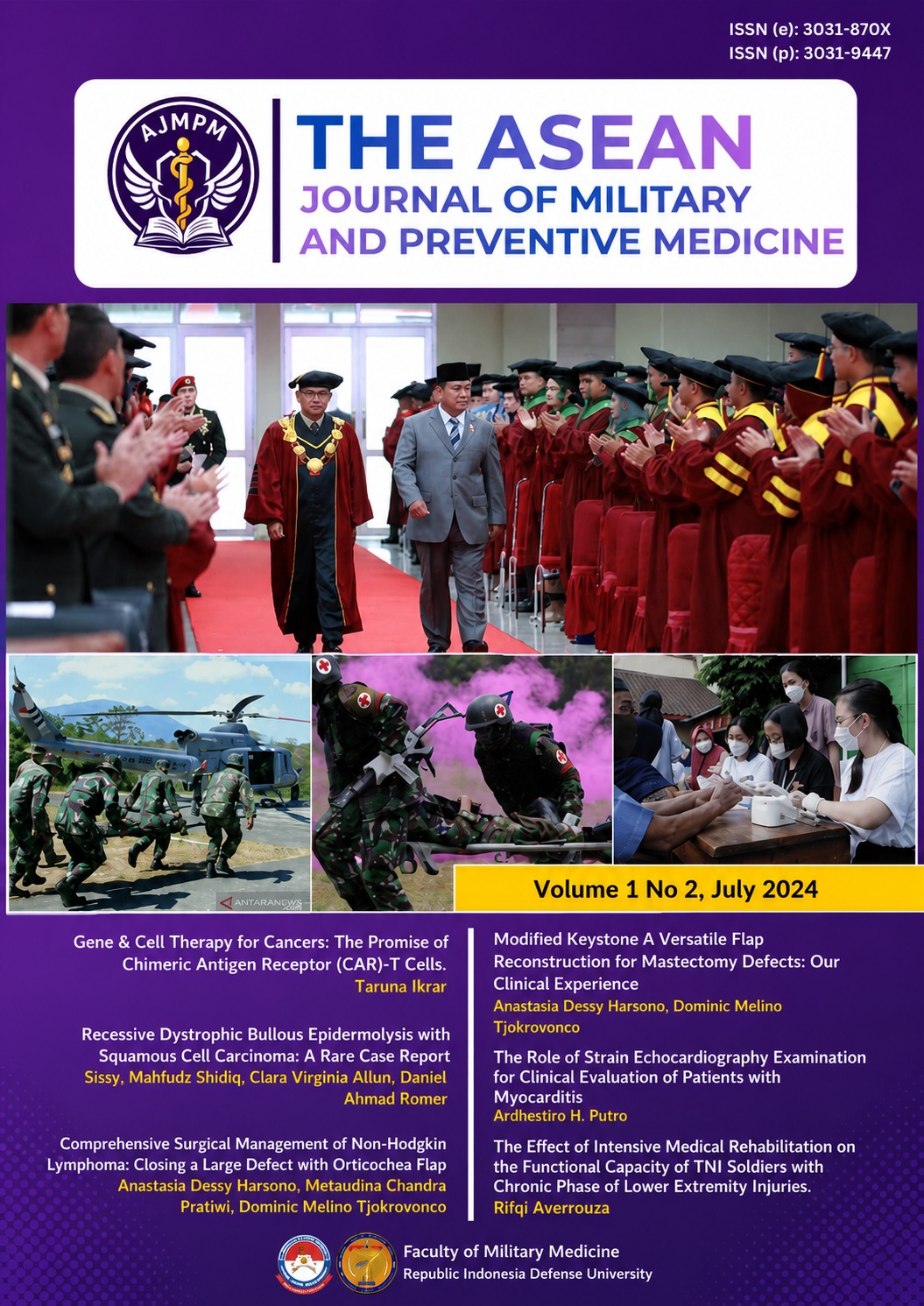
The Effect of Intensive Medical Rehabilitation on the Functional Capacity of TNI Soldiers with Chronic Phase of Lower Extremity Injuries
DOI:
https://doi.org/10.47353/ajmpm.v1i2.14Keywords:
Disability, Musculoskeletal, Rehabilitation, Functional CapacityAbstract
Rehabilitation plays a crucial role in the recovery of patients, improving their quality of life and reducing the risk of complications by restoring a person's functional capacity after experiencing an injury. Chronic musculoskeletal injuries that are not handled optimally have the potential to cause disability for soldiers, making it impossible for soldiers to return to duty according to their main duties. Lower extremity injury is related to the potential reduction in a person's functional capacity, related to their functions, namely mobility, fitness, strength and agility. Active military soldiers with chronic lower extremity injuries underwent an intensive-structured medical rehabilitation program 3 times a week for 8 weeks. At the end of the rehabilitation program, statistically significant differences were found in the increase in cardiorespiratory fitness capacity and agility compared to pre-intervention. Even in chronic conditions, intensive medical and structural rehabilitation programs in cases of lower limb injuries can significantly increase functional capacity in assessing cardiorespiratory fitness and agility in accordance with TNI soldier fitness standards.
Downloads
References
Pusat Rehabilitasi (Internet). 2024 (cited 2024 May 10). Available from : https://www.kemhan.go.id/pusrehab/data-penyandang-disabilitas
Perna Andre, Proietti Luca. Editorial on: Musculoskeletal Rehabilitation: Current Challenges and New Perspectives. J Clin Med. 2023 Jun; 12(12): 3981
AR Burgess. Consequences and Costs of Lower Extremity Injuries. Annu Proc Assoc Adv Automot Med. 2004; 48: 339–353
Daniel I. Rhon, et al. Recovery, Rehabilitation, and Return to Full Duty in a Military Population After a Recent Injury: Differences Between Lower-Extremity and Spine Injuries. Arthroscopy, Sports Medicine, and Rehabilitation, Vol 4, No 1 (January), 2022: pp e17-e27
Kwang-Jun Ko, Gi-Chul Ha, Dong-Woo Kim, Seol-Jung Kang. Effects of lower extremity injuries on aerobic exercise capacity, anaerobic power, and knee isokinetic muscular function in high school soccer players. J. Phys. Ther. Sci. 29: 1715–1719, 2017
Poplin G, Roe D, Peate W, Harris R. The Association of Aerobic Fitness with Injuries in the Fire Service. American Journal of Epidemiology. 179(2), 2013.
Fabio Sarto et al. Do lower limb previous injuries affect balance performance? An observational study in volleyball players. Physical Therapy in Sport 37: 49-53, 2019
Hammami Mehrez. Effects of Lower-Limb Strength Training on Agility, Repeated Sprinting With Changes of Direction, Leg Peak Power, and Neuromuscular Adaptations of Soccer Players. The Journal of Strength and Conditioning Research 32(1):1, 2017
Irma Ruslina Defi. Rehabilitation Role in Sport Injury. The Orthopaedic Journal of Sports Medicine, 11(2)(suppl1). 2023
Cooper L, Taylor N, Feller J. A Systematic review of the Effect of Proprioceptive and Balance Exercises on People with an Injured or Reconstructed Anterior Cruciate Ligament. Research in Sports Medicine An International Journal 13(2): 163-78. 2005
Vathrakokilis K et al. Effects of a Balance Training Protocol on Knee Joint Proprioception After Anterior Cruciate Ligament Reconstruction. Journal Back and Musculosceletal Rehabilitation 21(4): 233-237. 2008
Downloads
Published
How to Cite
Issue
Section
License
Copyright (c) 2024 Rifqi Averrouza

This work is licensed under a Creative Commons Attribution 4.0 International License.