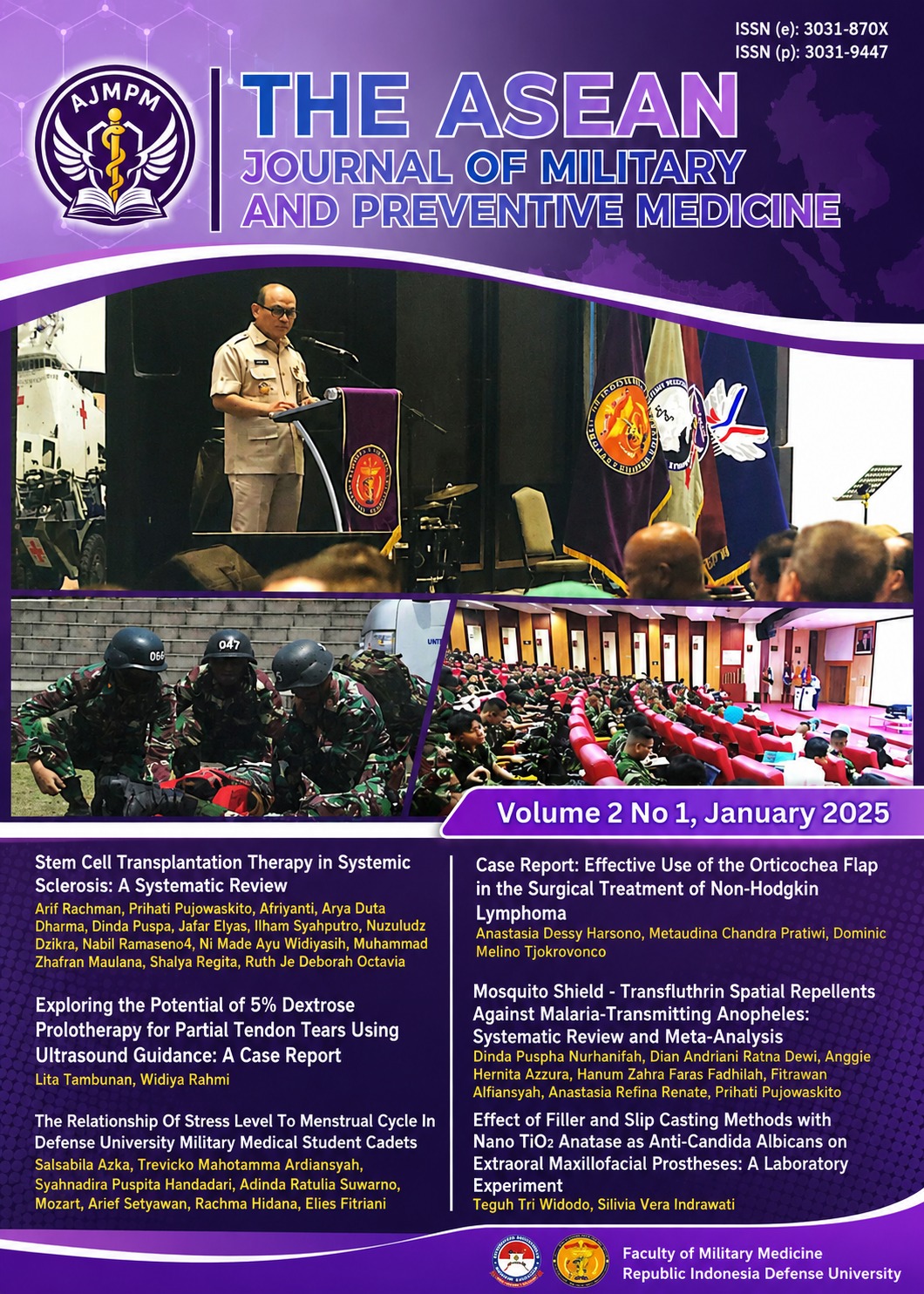
Effect of Filler and Slip Casting Methods with Nano TiO2 Anastase as Anti-Candida Albicans on Extraoral Maxillofacial Prostheses: A Laboratory Experiment
DOI:
https://doi.org/10.47353/ajmpm.v2i1.25Keywords:
Candida albicans, laboratory experiment, maxillofacial prosthesis, polyurethane, TiO₂ anataseAbstract
Background: Polyurethane is widely used for extraoral maxillofacial prostheses because of its favorable elasticity, tear resistance, and tissue-like surface characteristics. However, polyurethane surfaces may support Candida albicans adhesion and biofilm formation, which may compromise prosthesis hygiene and durability. This study aimed to evaluate the antifungal effect of anatase titanium dioxide (TiO₂) nanoparticles applied to polyurethane plates using filler and slip-casting coating methods.
Methods: This in vitro laboratory experimental study used 54 polyurethane plates divided into nine groups: one control group, four filler groups with 1%, 2%, 3%, and 4% TiO₂, and four slip-casting coating groups with 1%, 2%, 3%, and 4% TiO₂. Treated samples were irradiated with ultraviolet light at 366 nm for 1 hour, exposed to Candida albicans suspension, incubated for 48 hours at 37°C, cultured on Sabouraud Dextrose Agar, and counted as CFU/mL. Data were analyzed using the Kolmogorov-Smirnov test, Levene’s test, Welch-ANOVA, and Games-Howell post hoc test.
Results: The 4% TiO₂ slip-casting coating group showed the lowest mean colony count (128.83 ± 7.96 CFU/mL), while the control group showed the highest count (272.00 ± 47.44 CFU/mL). Welch-ANOVA showed significant differences among groups (F = 37.664; p < 0.001).
Conclusion: Surface coating with 4% anatase TiO₂ using slip casting produced the greatest inhibitory effect against Candida albicans on polyurethane plates in this laboratory model.
Downloads
References
1. Bhola RD, Pisulkar SGK, Godbole SAD, Purohit HS, Borle AB. Maxillofacial prosthesis for combined intra and extra-oral defect: a case report. J Evol Med Dent Sci. 2021;10(8):550-554. doi:10.14260/jemds/2021/119.
2. Djunaedy YMI. Protesa maksilo fasial kerangka logam kombinasi bahan termoplastik pada defek kelas II Aramany pasca hemimaxillectomy. Maj Ked Gigi Indo. 2016;19(1):89. doi:10.22146/majkedgiind.15923.
3. Cobein MV, Coto NP, Crivello Junior O, Lemos JBD, Vieira LM, Pimentel ML, et al. Retention systems for extraoral maxillofacial prosthetic implants: a critical review. Br J Oral Maxillofac Surg. 2017;55(8):763-769. doi:10.1016/j.bjoms.2017.04.012.
4. Phasuk K, Haug SP. Maxillofacial prosthetics. Oral Maxillofac Surg Clin North Am. 2018;30(4):487-497. doi:10.1016/j.coms.2018.06.009.
5. Ghazali N, Tengku Mohd Ariff TF. Fundamental properties and biocompatibility classification of extraoral prostheses: a review. J Med Dev Technol. 2023;2(1):19-30. doi:10.11113/jmeditec.v1n1.27.
6. Gad M, Al-Thobity AM, Shahin S, Alsaqer B, Ali A. Inhibitory effect of zirconium oxide nanoparticles on Candida albicans adhesion to repaired polymethyl methacrylate denture bases and interim removable prostheses. Int J Nanomedicine. 2017;12:5409-5419. doi:10.2147/IJN.S142857.
7. Pessoa RS, Junior WC, Testoni GE, Filho GP, Maciel HS. On the influence of conductor, semiconductor and insulating substrate on the structure of atomic layer deposited titanium dioxide thin films. In: 2018 33rd Symposium on Microelectronics Technology and Devices; 2018. doi:10.1109/SBMICRO.2018.8511504.
8. Jaelani IM, Sari WP, Fadriyanti O. Effect of the concentration of non-dental glass fiber on reinforced acrylic resin on the attachment of Candida albicans. J Ked Gigi Univ Padj. 2019;31(2). doi:10.24198/jkg.v31i2.23450. [Reference details need to be completed by author]
9. Mothibe JV, Patel M. Pathogenic characteristics of Candida albicans isolated from oral cavities of denture wearers and cancer patients wearing oral prostheses. Microb Pathog. 2017;110:128-134. doi:10.1016/j.micpath.2017.06.036.
10. Alrahlah A, Fouad H, Hashem M, Niazy A, AlBadah A. Titanium oxide (TiO₂)/polymethylmethacrylate denture base nanocomposites: mechanical, viscoelastic and antibacterial behavior. Materials (Basel). 2018;11(7):1096. doi:10.3390/ma11071096.
11. Anwander M, Rosentritt M, Schneider-Feyrer S, Hahnel S. Biofilm formation on denture base resin including ZnO, CaO, and TiO₂ nanoparticles. J Adv Prosthodont. 2017;9(6):482. doi:10.4047/jap.2017.9.6.482.
12. Totu EE, Nechifor AC, Nechifor G, Aboul-Enein HY, Cristache CM. Poly(methyl methacrylate) with TiO₂ nanoparticles inclusion for stereolithographic complete denture manufacturing. J Dent. 2017;59:68-77. doi:10.1016/j.jdent.2017.02.012.
13. Cabrera-Rodríguez O, Trejo-Valdez MD, Torres-SanMiguel CR, Pérez-Hernández N, Bañuelos-Hernández Á, Manríquez-Ramírez ME, et al. Evaluation of TiO₂ thin films doped with silver nanoparticles as a protective coating for metal prostheses. Surf Coat Technol. 2023;458:129349. doi:10.1016/j.surfcoat.2023.129349.
14. Zore A, Abram A, Učakar A, Godina I, Rojko F, Štukelj R, et al. Antibacterial effect of polymethyl methacrylate resin base containing TiO₂ nanoparticles. Coatings. 2022;12(11):1757. doi:10.3390/coatings12111757.
15. Putranti DT, Fadilla A. Titanium dioxide addition to heat polymerized acrylic resin denture base: effect on Staphylococcus aureus and Candida albicans. J Indones Dent Assoc. 2018;1(1). doi:10.32793/jida.v1i1.286. [Reference details need to be completed by author]
16. Guo Q, Zhou C, Ma Z, Yang X. Fundamentals of TiO₂ photocatalysis: concepts, mechanisms, and challenges. Adv Mater. 2019;31(50):1901997. doi:10.1002/adma.201901997.
17. Khalaf HA, Salman TA. The influence of adding modified ZrO₂-TiO₂ nanoparticles on certain physical and mechanical properties of heat polymerized acrylic resin. J Baghdad Coll Dent. 2015;27(3):33-39. doi:10.12816/0015032.
18. Tandra E, Wahyuningtyas E, Sugiatno E. The effect of nanoparticles TiO₂ on the flexural strength of acrylic resin denture plate. Padjadjaran J Dent. 2018;30(1):35. doi:10.24198/pjd.vol30no1.16110.
19. Dehis W, Eissa S, Elawady A, Elhotaby M. Impact of nano-TiO₂ particles on water sorption and solubility in different denture base materials. J Arab Soc Med Res. 2018;13(2):99. doi:10.4103/jasmr.jasmr_27_18.
20. Naji SA, Kashi TSJ, Pourhajibagher M, Behroozibakhsh M, Masaeli R, Bahador A. Evaluation of antimicrobial properties of conventional polymethyl methacrylate denture base resin materials containing silver-doped titanium dioxide nanoparticles against cariogenic bacteria and Candida albicans. IP Ann Prosthodont Restor Dent. 2023;9(4):206-213. doi:10.18231/j.aprd.2023.039.
21. Widodo TT, Siswomiharjo W, Sunarintyas S, Yulianto DK. Effect of method and concentration of titanium dioxide addition on anti-biofilm ability in extraoral maxillofacial prosthetic fungus. Int J Adv Med. 2023;10(1):1-9. doi:10.18203/2349-3933.ijam20223332.
22. Kumar A, Seenivasan MK, Inbarajan A. A literature review on biofilm formation on silicone and polymethyl methacrylate used for maxillofacial prostheses. Cureus. 2021;13(11):e20029. doi:10.7759/cureus.20029.
23. El Shafie SY, El Shimy AM, Elsheredy AG, Moustafa M. Antifungal effect of photocatalytic nano-titanium dioxide incorporated in silicone elastomer. Alexandria Dent J. 2019;44(2):52-60. doi:10.21608/adjalexu.2019.57363.
24. Tatlıdil İ, Sökmen M, Breen C, Clegg F, Buruk CK, Bacaksız E. Degradation of Candida albicans on TiO₂ and Ag-TiO₂ thin films prepared by sol-gel and nanosuspensions. J Sol-Gel Sci Technol. 2011;60(1):23-32. doi:10.1007/s10971-011-2546-0.
25. Altarazi A, Jadaan L, McBain AJ, et al. 3D-printed nanocomposite denture base resin: the effect of incorporating TiO₂ nanoparticles on the growth of Candida albicans. J Prosthodont. 2024;33(1). doi:10.1111/jopr.13784.
Downloads
Published
How to Cite
Issue
Section
License
Copyright (c) 2025 Teguh Tri Widodo, Silvia Vera Indrawati

This work is licensed under a Creative Commons Attribution 4.0 International License.