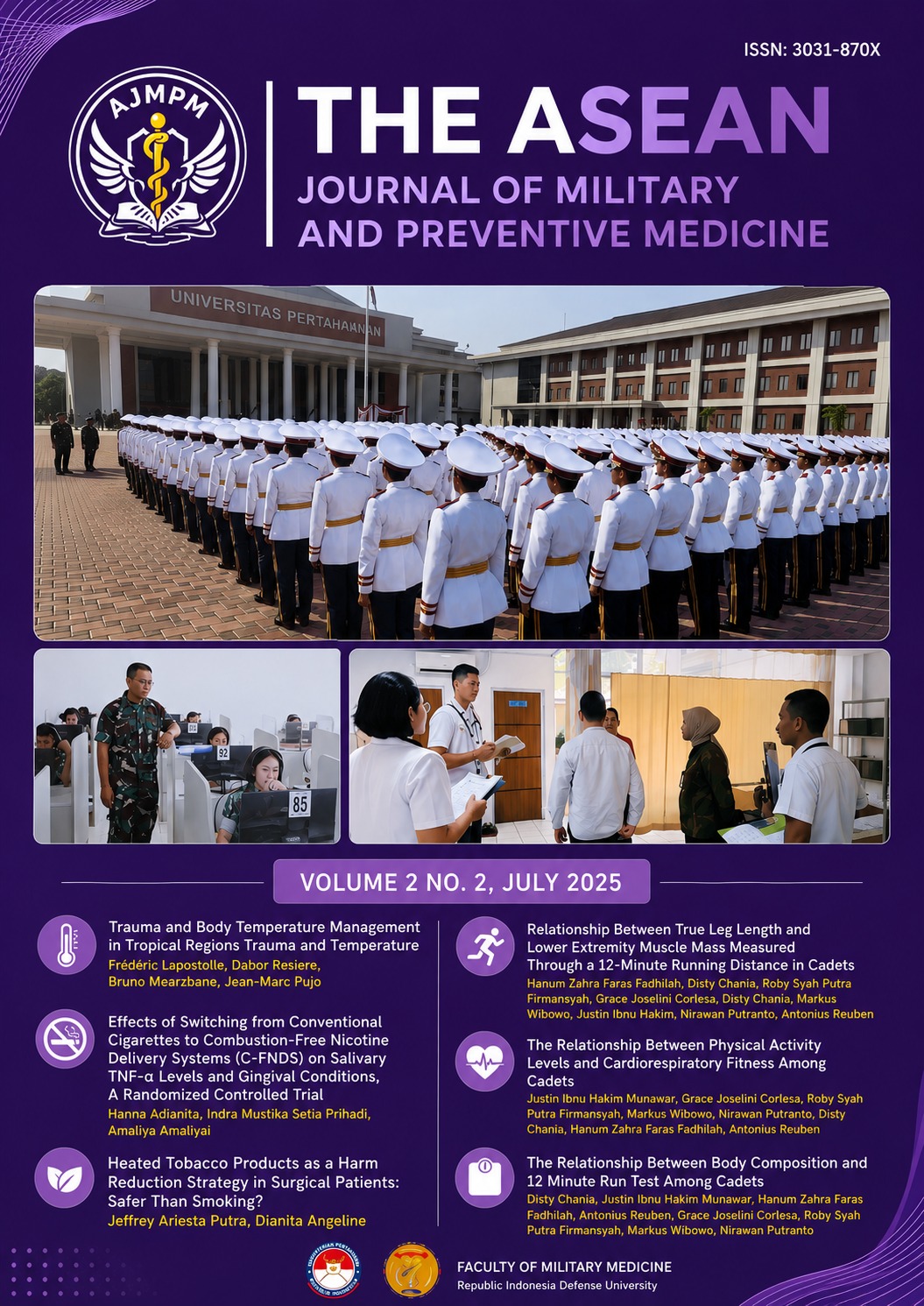
Heated Tobacco Products as a Harm Reduction Strategy in Surgical Patients Safer Than Smoking? : A Review Article
DOI:
https://doi.org/10.47353/ajmpm.v2i2.31Keywords:
heated tobacco products; wound healing; surgery; smoking cessation; harm reduction; perioperative riskAbstract
Background: Tobacco smoking is a well-established modifiable risk factor for poor postoperative outcomes, including delayed wound healing, increased infection risk, wound dehiscence, tissue hypoxia, and cardiopulmonary complications. In Indonesia, smoking prevalence remains high among surgical patients, while access to and compliance with preoperative cessation interventions remain limited. Heated tobacco products (HTPs), which deliver nicotine by heating rather than combusting tobacco, have emerged as a potential harm reduction alternative; however, their role and safety in surgical populations remain uncertain. Objective: This review aimed to evaluate current biological, toxicological, and clinical evidence comparing HTPs with conventional cigarettes in relation to wound healing and perioperative complications, and to assess their potential role as a harm reduction strategy in surgical patients. Methods: A narrative review was conducted using literature obtained from PubMed, Scopus, and Google Scholar, supplemented by grey literature from authoritative public health institutions. Publications from January 2010 to June 2025 were considered. Eligible studies included original articles, reviews, systematic reviews, human clinical studies, observational studies, and relevant preclinical studies reporting toxicological profiles, tissue oxygenation, immune response, inflammation, endothelial function, wound healing, infection, or perioperative complications. Data were extracted and synthesized thematically. Discussion: Conventional cigarette combustion generates numerous harmful substances, including tar, carbon monoxide, polycyclic aromatic hydrocarbons, tobacco-specific nitrosamines, aldehydes, heavy metals, and reactive oxygen species, which contribute to endothelial dysfunction, vasoconstriction, tissue hypoxia, oxidative stress, immune suppression, impaired fibroblast activity, reduced collagen synthesis, delayed wound healing, surgical site infection, and wound dehiscence. HTPs avoid direct combustion and may substantially reduce exposure to tar, carbon monoxide, and selected toxicants, potentially supporting better tissue oxygenation, vascular function, and microvascular perfusion. However, HTP aerosols still contain nicotine, volatile organic compounds, aldehydes, heavy metals, and tobacco-specific nitrosamines, which may continue to interfere with wound healing. Current evidence suggests that HTPs may pose a lower biological risk than conventional cigarettes, but direct clinical evidence in surgical populations remains limited. Conclusion: HTPs may offer a transitional harm reduction option for selected surgical patients unable or unwilling to achieve complete smoking cessation. Nevertheless, HTPs are not risk-free and should not replace complete smoking cessation as the standard of care for minimizing perioperative complications. Further prospective clinical trials and wound healing studies are required to evaluate the safety and effectiveness of HTPs in surgical populations.
Downloads
References
1. Schmid M, Sadasivan KK, Dindo D, Clavien PA, Hahnloser D. Impact of smoking on perioperative outcomes after major surgery. Am J Surg. 2015;210(2):221-229. doi:10.1016/j.amjsurg.2014.12.045.
2. Grasbeck HL, Reito A, Ekroos H, Aakko JA, Holsa O, Vasankari T. Smoking is a predictor of complications in all types of surgery: a machine learning-based big data study. BJS Open. 2023;7(2). doi:10.1093/bjsopen/zrad016.
3. Chiang YF, Lee Y, Lam F, Liao C, Chang C, Lin C. Smoking increases the risk of postoperative wound complications: a propensity score-matched cohort study. Int Wound J. 2022;20(2):391. doi:10.1111/iwj.13887.
4. Reddy VV, Lakshmi M, Rani SS, Rao AV, Satyanarayana G, Murthy PV. Perioperative cardiopulmonary complications in smokers and non-smokers undergoing elective surgery: a prospective study. J Pharmacol Pharmacother. 2024;15(2):171. doi:10.1177/0976500x241246412.
5. Global Adult Tobacco Survey (GATS). Indonesia report 2021. Jakarta: Ministry of Health, Republic of Indonesia; 2022.
6. Fawwaz SM, Pardede DKB. Dampak kebiasaan merokok terhadap risiko anestesi dan pembedahan. Cermin Dunia Kedokteran. 2023;50(10):928.
7. Omaiye EE, McWhirter KJ, Luo W, Pankow JF, Talbot P. Selected harmful and potentially harmful constituents levels in commercial e-cigarettes. Tob Control. 2019;28(6):678-687.
8. Williams M, Villarreal A, Bozhilov K, Lin S, Talbot P. Metal and silicate particles including
nanoparticles are present in electronic cigarette cartomizer fluid and aerosol. PLoS One. 2013;8(3):e57987.
9. Sundar IK, Javed F, Romanos GE, Rahman I. E-cigarettes and flavorings induce inflammatory and pro-senescence responses in oral epithelial cells and periodontal fibroblasts. Oncotarget. 2016;7(47):77196-77204.
10. Goniewicz ML, Gawron M, Smith DM, Peng M, Jacob P 3rd, Benowitz NL. Exposure to nicotine and selected toxicants in cigarette smokers who switched to electronic cigarettes: a longitudinal within-subjects observational study. Nicotine Tob Res. 2017;19(2):160-167.
11. Royal College of Physicians. E-cigarettes and harm reduction: an evidence review. London: RCP; 2024.
12. Lau D, Berger MS, Khullar D, Maa J. The impact of smoking on neurosurgical outcomes. J Neurosurg. 2013;119(5):1323. doi:10.3171/2013.5.jns122287.
13. Galvan CCR, Cataneo AJM. Effect of respiratory muscle training on pulmonary function in preoperative preparation of tobacco smokers. Acta Cir Bras. 2007;22(2):98. doi:10.1590/s0102-86502007000200004.
14. Varga J. Smoking and pulmonary complications: respiratory prehabilitation. J Thorac Dis. 2019;11. doi:10.21037/jtd.2018.12.11.
15. Kozub MI, Gachewicz B, Kasprzyk M, Roszak M, Gasiorowski L, Dyszkiewicz W. Impact of smoking history on postoperative complications after lung cancer surgery - a study based on 286 cases. Pol J Cardio-Thorac Surg. 2019;16(1):13. doi:10.5114/kitp.2019.83940.
16. Mathews B, Spear M. The surgical impact of e-cigarettes: a case report and review of the current literature. Plast Reconstr Surg Glob Open. 2017;5(10):e1534.
17. Callahan-Lyon P. Electronic cigarettes - a review of the physiological health effects. FACETS. 2014;1(1):377-403.
18. Weiss KD, Napoli A, DeMeester SR. Perioperative implications of vaping. J Anesth Clin Res. 2021;12(3):1-10.
19. Sorensen LT. Wound healing and infection in surgery: the pathophysiological impact of smoking, smoking cessation, and nicotine replacement therapy: a systematic review. Ann Surg. 2012;255(6):1069-1079.
20. Taghavi SA, Noroozi M, Mokhberi V. The implications of vaping on surgical wound healing: a systematic review. Surgery. 2023;173(4):1-10.
21. Wang W, Zhao T, Geng K, Yuan G, Chen Y, Xu Y. Smoking and the pathophysiology of peripheral artery disease. Front Cardiovasc Med. 2021;8:704106. doi:10.3389/fcvm.2021.704106.
22. Xia N, Morteza A. A review of the role of cigarette smoking in the diabetic foot. J Diabetes Investig. 2019;10:202-215.
23. Sorensen LT. The effects of smoking on the wound healing process. J Wound Care. 2010;19(1):5-8.
24. Inoue Y, Murakami T, Kaneko T, Matsumoto K, Yoshikawa M. Perioperative complications of abdominal surgery in smokers. J Anesth. 2020;34(5):712. doi:10.1007/s00540-020-02815-6.
25. Qiu F, Liang CL, Liu H, Zeng YQ, Hou S, Huang S, Lai X, Dai Z. Impacts of cigarette smoking on immune responsiveness: Up and down or upside down? Oncotarget. 2017;8(1):268-284.
26. Pierce L, Keogh B, Fox B. Smoking increases the risk of postoperative wound complications: a propensity score-matched cohort study. J Surg Oncol. 2023;127(1):1-10.
27. Yamashita S, Kawamura T, Sugita K, Sugita Y, Nakamura Y. Effect of smoking on intraoperative sputum and postoperative pulmonary complication in minor surgical patients. Respir Med. 2004;98(8):760. doi:10.1016/j.rmed.2004.01.011.
28. Senker W, Stefanits H, Gmeiner M, Trutschnig W, Radl C, Gruber A. The influence of smoking in minimally invasive spinal fusion surgery. Open Med. 2021;16(1):198. doi:10.1515/med-2021-0223.
29. Brajcich BC, Stulberg JJ, Huang R, Ujiki MB, Chung JW. Association of preoperative smoking with complications following major gastrointestinal surgery. Am J Surg. 2021;223(2):312. doi:10.1016/j.amjsurg.2021.06.002.
30. Giebe S, Hoffmann A. Comparative study of the effects of cigarette smoke versus next generation tobacco and nicotine product extracts on endothelial function. Redo Biol. 2021;47:102150.
Downloads
Published
How to Cite
Issue
Section
License
Copyright (c) 2025 Jeffrey Ariesta Putra, Dianita Angeline

This work is licensed under a Creative Commons Attribution 4.0 International License.